ADHD & Entrepreneurship: What the Biggest Study Shows
The biggest study ever done on ADHD and entrepreneurship has a clear message for founders: the traits that get you off the start line aren’t the ones that keep you winning — and the gap between them is the most coachable thing there is.

In tennis, a huge serve wins you free points all afternoon. It does not win you the match. The match is the second serve, the footwork, and the unglamorous discipline of resetting between points when your head is still on the last one. The weapon opens the door. Something far less dramatic walks you through it.
It turns out that founding a business works the same way, and now there’s data to prove it.
What the research looked at
In 2026, a team led by Mi Hoang Tran and Johan Wiklund published the largest review of its kind in Entrepreneurship Theory & Practice, one of the field’s most respected journals. They pooled 298 results from 47 separate studies to settle a question people have argued about for a decade: Does ADHD help or hurt entrepreneurs?
Their answer reframes the whole debate. It’s not “help” or “hurt.” It depends on which ADHD trait you mean, and which stage of the business you’re looking at.
298 results, drawn from 47 studies — the largest body of evidence on ADHD and entrepreneurship assembled to date (Tran et al., 2026).
Every business has three stages
The whole finding rests on splitting a venture into three simple phases:
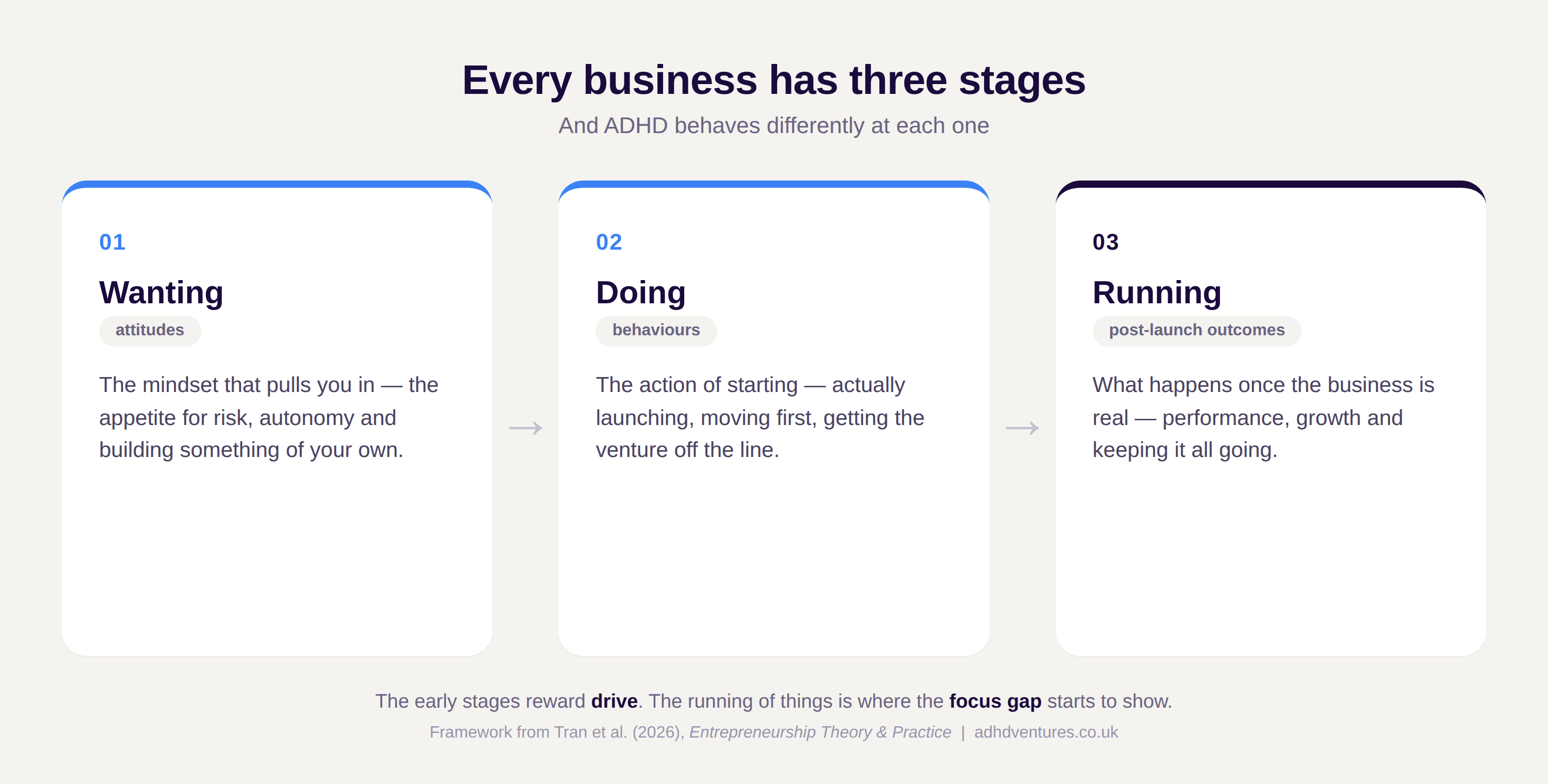
Tran and colleagues split entrepreneurship into the mindset that pulls you in (attitudes), the act of starting (behaviours), and what happens once the business is up and running (post-launch outcomes). ADHD behaves differently at each one.
What they found
When you track the two main sides of ADHD across those three stages, a pattern appears. The restless, impulsive, high-energy side — call it drive — pushes people toward starting and into action. The focus gap (inattention) does something different: it barely touches the early stages, but it quietly drags on the business once it’s up and running.
Numbers are correlations from Tran et al. (2026). A correlation of 0 means no link; in this field, anything from about 0.1 upward is a meaningful signal. Drive nudges you toward wanting and doing, then stops mattering. Inattention sits quietly until the business has to be run, then it pulls results down.
Here’s the same thing as a simple grid:
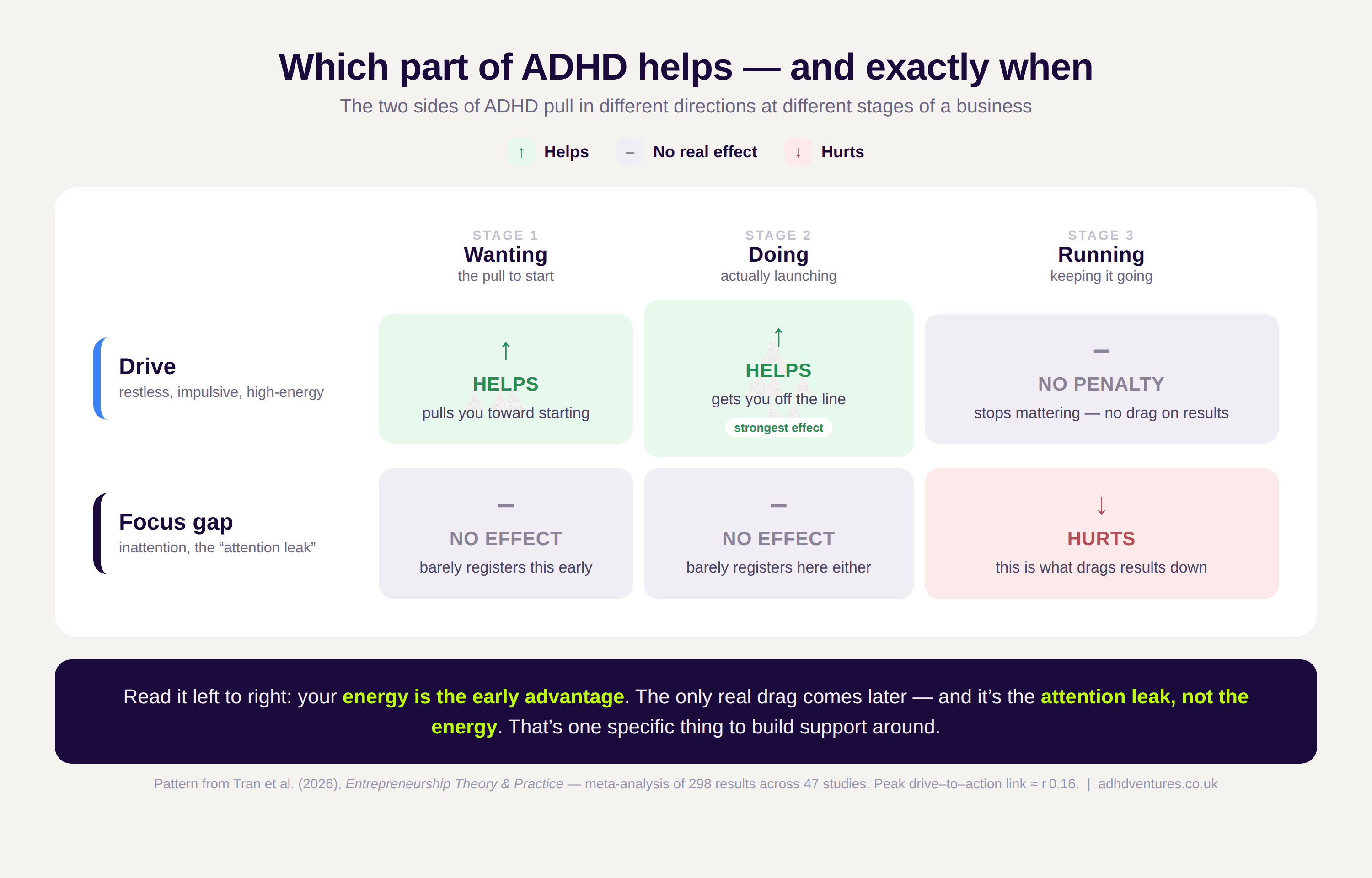
The pattern in one picture (Tran et al., 2026). Look at ADHD overall, or a formal diagnosis, and the same shape holds: a positive nudge toward starting, a negative pull on results.
The bit almost everyone gets wrong
It would be easy to read “hurts results” as “ADHD makes you a worse founder.” The data says something far more precise. When the researchers separated the two traits, the drag on business performance was driven specifically by the focus gap (inattention), not by the restless, impulsive energy. The drive showed no meaningful negative link to results at all.
In plain terms, the bold, fast-moving, “let’s just go” energy isn’t the problem later on. The attention leak is. That’s a much kinder and much more useful message, because it points at one specific thing to build support around, instead of vaguely blaming the whole way your brain works.
Why this is genuinely good news
Here’s the part that should change how you think about your own wiring. In a conventional job, ADHD traits are reliably linked to worse outcomes: lower performance, higher turnover. In founding, that same drive shows no penalty on results. The cost simply disappears.
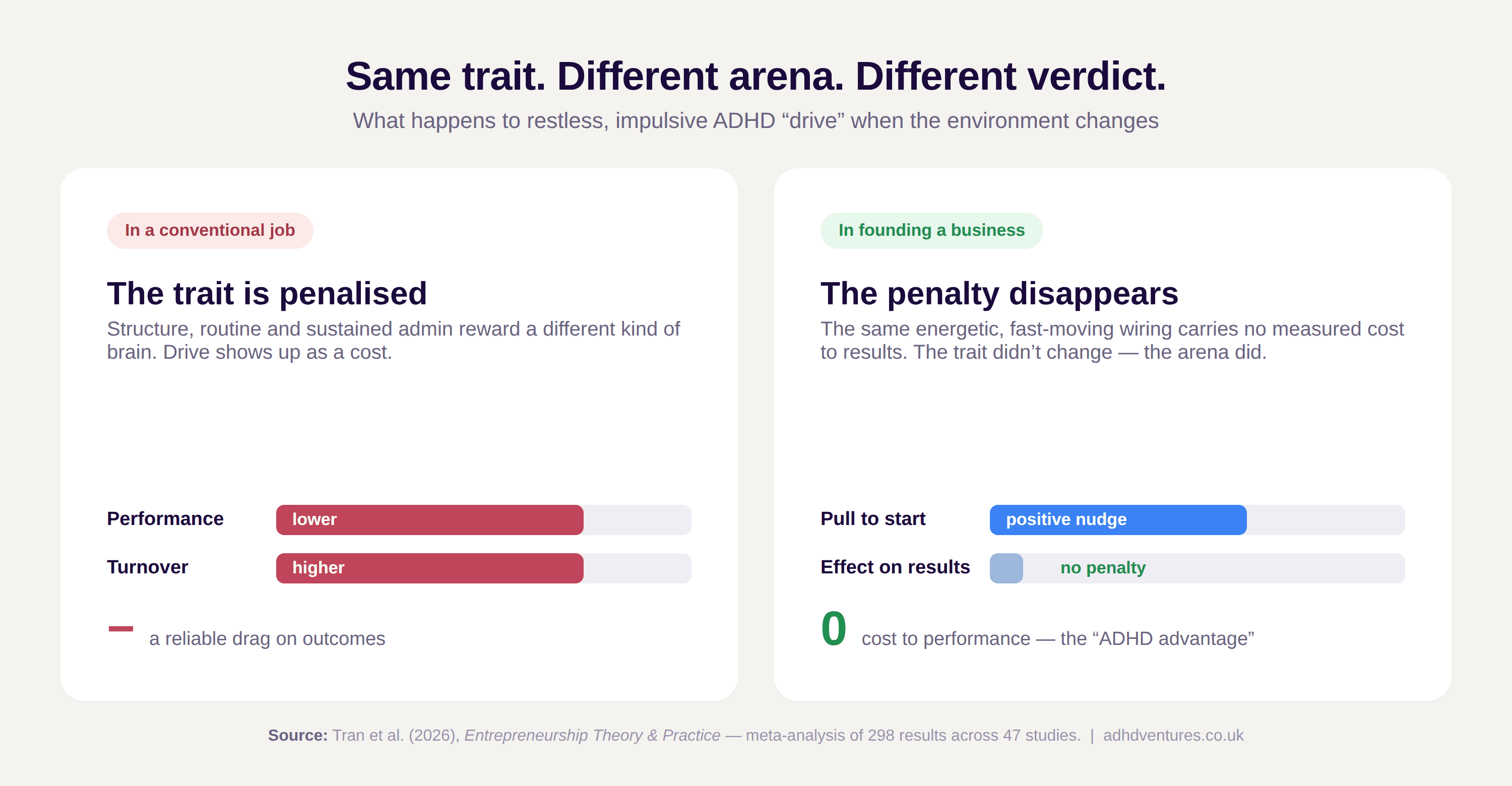
The same energetic, impulsive traits that drag down results in traditional employment carry no measured penalty for founders (Tran et al., 2026). The trait didn’t change; the environment did. That’s the real “ADHD advantage”: founding is one of the few arenas that stops punishing how your brain already works.
To be fair about scale: these links are real but modest — the strongest, drive nudging you toward action, sits at a correlation of about 0.16. That can sound small. But a founder’s overall experience and skill — one of the best known predictors of business success — shows an even smaller average link, around 0.05 (Unger et al., 2011, as reported in Tran et al., 2026). In the real world, small advantages compound into big differences over the life of a business.
And it can get stronger with experience
If Tran’s study showed the raw-trait advantage fading after launch, a second piece of research suggests it doesn’t have to. Artamoshina and colleagues (2023) studied 367 small and mid-sized companies and found that CEOs with more ADHD symptoms drove more business-model innovation; reinventing what the company offers, how it’s built, and how it makes money. The striking part: the effect was strongest among longer-serving CEOs. Experience seemed to turn restless, opportunity-hungry ADHD traits into structured reinvention rather than chaos.
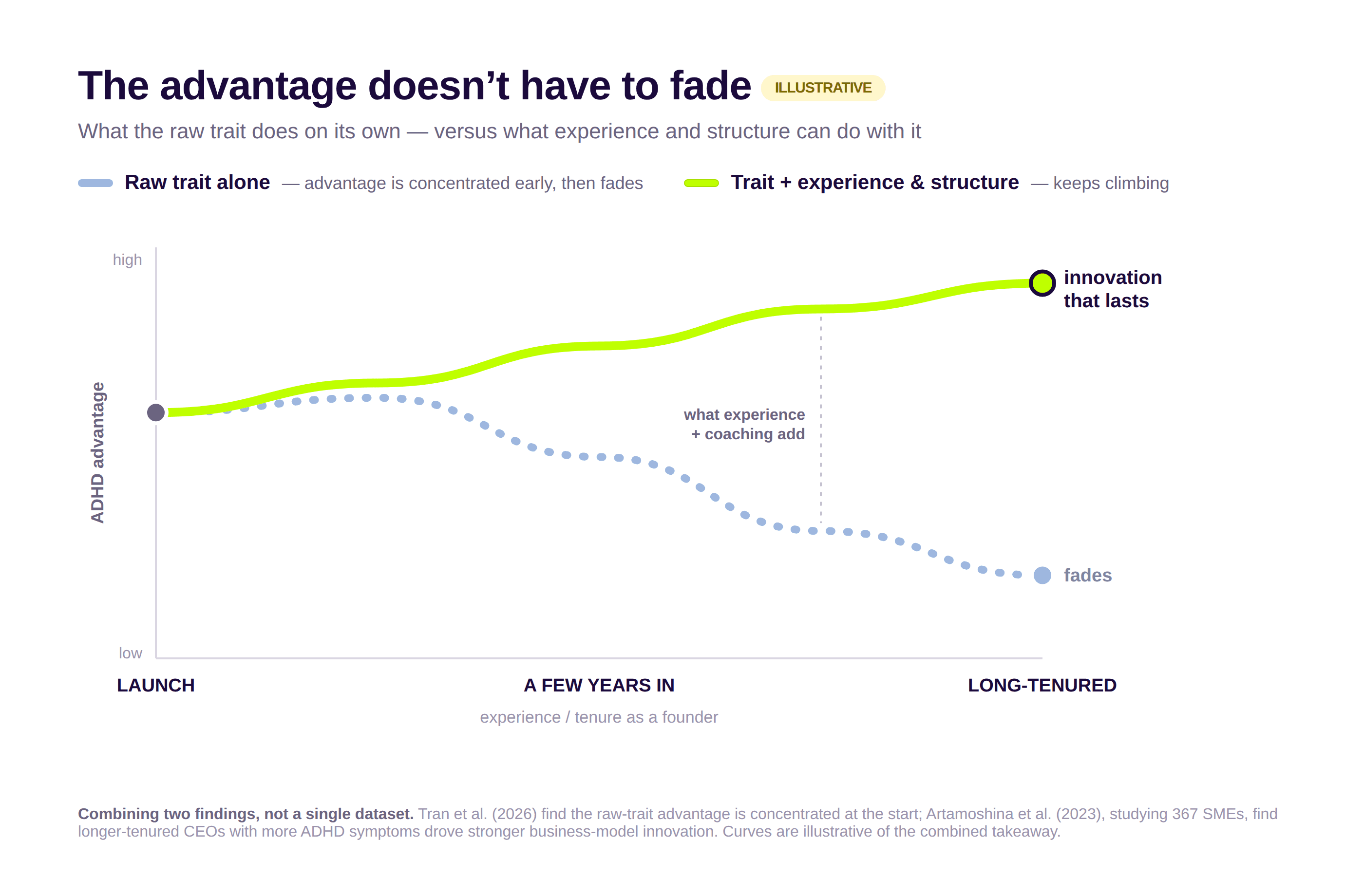
Illustrative — combining two findings, not a single dataset. Tran et al. (2026) show the raw-trait advantage is concentrated early; Artamoshina et al. (2023) show that more experienced (longer-tenured) ADHD leaders drove stronger innovation. The takeaway: experience and structure can keep the advantage climbing.
So the real picture isn’t “great start, inevitable fade.” It’s this: the trait opens the door, and experience and structure — the very things coaching is built to develop — turn it into lasting innovation. Tenure did some of that work on its own in the research. Deliberate support can accelerate the same curve.
One honest caveat: this study was conducted with Russian SMEs, so it’s best read as strong evidence from one national context rather than a universal rule — especially since broader research finds that culture and setting shape how ADHD traits manifest.
There’s a human cost the headline hides
One sobering finding sits underneath the performance story. Across the studies, more ADHD symptoms — both the restless kind and the inattentive kind — were linked to lower well-being for the founders themselves (Tran et al., 2026). The “successful but exhausted” founder isn’t the rare exception. Statistically, it’s the expected case. The traits can be neutral to good for the business while still taxing the person running it.
Where this leaves you
Put it all together and the message is hopeful, not deflating. The advantage is real and it’s yours. It’s concentrated at the start — the wanting and the doing. The wobble comes later, it’s specific (the focus gap, in the running of things), and it’s predictable. A vague weakness can’t be worked on. A located one can.
The review even hints at how much that matters. It found only two studies that tested whether support changes the picture — a wide-open question in the field. But one of them found that founders with ADHD who received support performed on a par with founders without ADHD (Greidanus & Liao, 2021). (The other was a useful caution: at a population level, more medication use went hand-in-hand with fewer businesses being started — a reminder that “support” isn’t one single thing (Peltonen et al., 2020).)
To go back to the tennis: the serve is a gift, and it’s genuinely yours. The footwork is the work. You don’t win by serving harder — you win by building the rest of your game around the weapon you already have.
A note on how solid this is. This is a peer-reviewed meta-analysis in a leading journal — the strongest tier of evidence. The caveats: most of the underlying studies are snapshots in time rather than long-term tracking, they lean heavily toward Europe and North America, and they include more men than women, worth remembering, given how often women’s ADHD goes undiagnosed.
Brilliant at starting, leaking value once it’s running? That gap between the start line and the long game is exactly the work — and it’s learnable. That’s what we do at ADHD Ventures.
References
Tran, M. H., Wiklund, J., Antshel, K., Jhawar, N., & Montgomery, C. (2026). Entrepreneurship and ADHD: A Meta-Analytical Assessment of the State-of-the-Art and Suggestions for the Future. Entrepreneurship Theory and Practice, 50(3), 789–829. https://doi.org/10.1177/10422587251392498
Artamoshina, P., Shirokova, G., Osiyevskyy, O., & Bodolica, V. (2023). ADHD symptoms of CEOs and business model innovation in the SME context. Technovation, 128, 102845. https://doi.org/10.1016/j.technovation.2023.102845
Greidanus, N. S., & Liao, C. (2021). Toward a coping-dueling-fit theory of the ADHD–entrepreneurship relationship: Treatment’s influence on business venturing, performance, and persistence. Journal of Business Venturing, 36(2), 106087.
Peltonen, J., Johansson, E., & Wincent, J. (2020). Does attention-deficit hyperactivity disorder medication reduce entrepreneurship? Health Economics, 29(9), 1071–1077.
Unger, J. M., Rauch, A., Frese, M., & Rosenbusch, N. (2011). Human capital and entrepreneurial success: A meta-analytical review. Journal of Business Venturing, 26(3), 341–358. (Effect-size comparison as reported in Tran et al., 2026.)