ADHD Coaching vs Therapy: Which Do You Need?
ADHD coaching and therapy aren't a hierarchy. Here's the real difference, who needs which (or both), and why performance coaching is its own category.
8-10 minutes

What ADHD Therapy Actually Does:
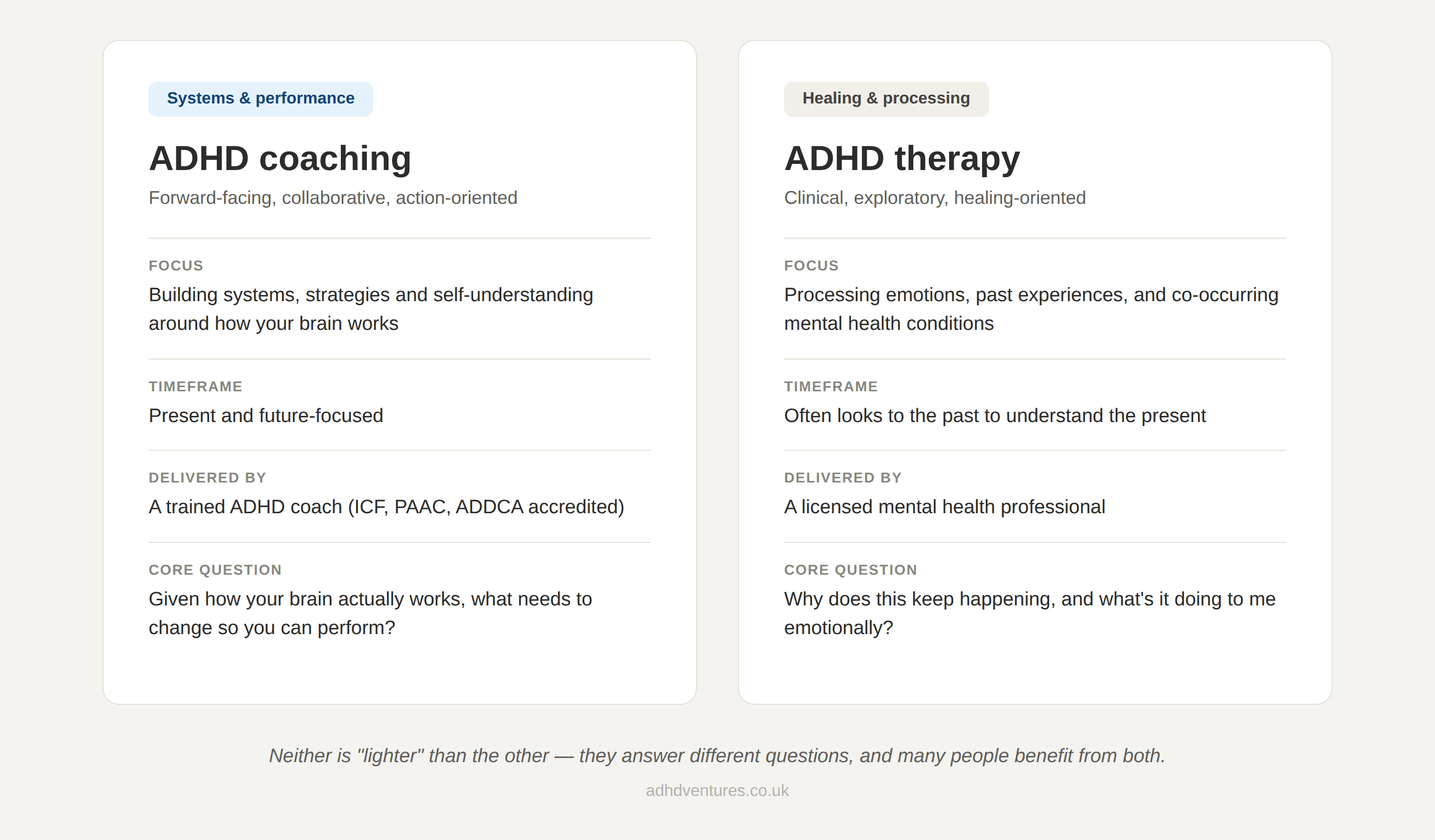
Therapy is a clinical process, delivered by a licensed mental health professional, focused on understanding and processing how ADHD has shaped your emotional life.
Approaches like CBT help you work through anxiety, low self-esteem, and shame that build up after years of being told you're lazy, disorganised, or "not living up to your potential." Some forms of therapy also address co-occurring conditions like depression, anxiety, and common issues alongside ADHD.
Therapy looks backwards as well as inward. It asks: why does this keep happening, and what's it doing to me emotionally?
That's valuable work, and for some people, it's essential, particularly if ADHD has been entangled with trauma, depression, or anxiety that needs clinical support before anything else can stick.
What ADHD Coaching Actually Does:
ADHD coaching is a structured, forward-focused partnership that builds systems, strategies, and self-understanding to help you function and perform in your daily life.
A coach doesn't explore your childhood or treat clinical conditions. Instead, they help you map how your brain operates: how you start tasks, sustain focus, manage time, and recover from setbacks, then build practical systems around that map.
Coaching asks a different question than therapy: given how your brain works, what needs to change about your environment, routines, and systems so you can do the things you want to do?
It's collaborative, not prescriptive. A good coach doesn't hand you a productivity system off the shelf; they help you build one that fits your operating system, not someone else's.
The Real Difference Isn't Severity, It's Direction:
Here's where most explanations of ADHD coaching vs therapy go wrong. They imply that coaching is for struggles that aren't "bad enough" for therapy, or that coaching is step one and therapy is for when things get serious.
This explanation is misleading and doesn't reflect how either discipline works.
Healing Vs Building
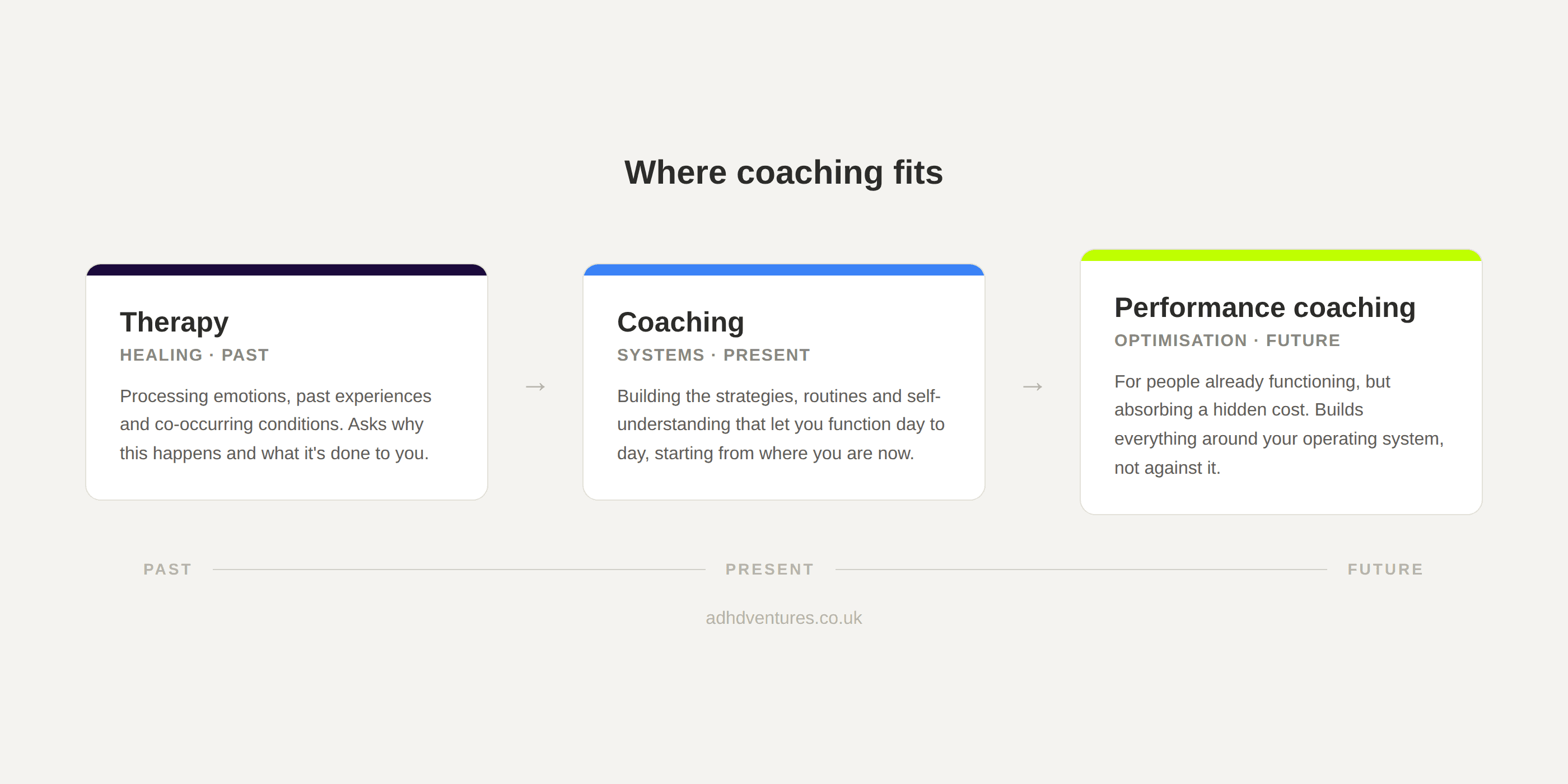
Therapy is oriented toward healing, processing what's happened, understanding emotional patterns and resolving what's keeping you stuck internally.
Coaching is oriented toward building, taking your brain's way of working as a given, and constructing the systems, habits and environment that let it perform.
You can need either, both or neither at any level of "severity". A high-functioning executive who has never struggled with mental health can still benefit from coaching because their systems are the bottleneck holding them back.
Past Vs Present
Therapy often works with the past to change the present.
Coaching starts in the present and works toward the future.
Neither direction is "more serious" than the other. They're different tools for different jobs, and plenty of people genuinely benefit from both, often at the same time, working with a therapist and a coach in parallel.
Why Performance Coaching Is A Different Category Again:
Here's where it gets more specific and where most content on ADHD coaching stops short. "ADHD coaching" covers a wide range of practice. Some coaches focus on daily living skills: getting out of the house on time, building basic routines, and managing deadlines. That's valuable work and for many, the right starting point.
Performance coaching is a different application of the same discipline, built for people already functioning, often very well by external measures, but running their operating systems inefficiently at a cost they quietly absorb.
Built For People Who Are Already Coping
If you're an executive who's hit every target while secretly working until midnight to compensate, an athlete whose focus is extraordinary in competition but chaotic everywhere else, or a founder who can build a business but can't build a filing system, coaching aimed at "getting by" isn't going to move the needle. You're already getting by. The cost is how you're getting by.
The Operating System Reframe
This is the lens ADHD+ coaching is built around: your ADHD brain isn't a deficient version of a neurotypical one, it's a different operating system, with its own logic for attention, motivation and energy.
A client of mine spent years assuming their working day should look the same from 9 to 5 - same focus, same output, hour after hour. When the afternoon slump hit, they read it as a discipline problem every time. Push through. Try harder. Drink more coffee.
What changed wasn't the slump; it was what they did with it. We mapped out their actual energy pattern across a typical day: sharp focus in the morning, a real dip in the early afternoon, with focus returning in the evening. Once that pattern was visible, the plan stopped being "try harder during the dip" and became "don't schedule deep work there at all." Client calls, easier admin or when the day allows a quick run or gym session, with the harder thinking moved to the hours either side.
The shift wasn't motivation. It was recognising that the system they were running, a flat, evenly distributed working day, was never going to fit the way their brain operates, no matter how hard they pushed against it.
The work isn't to fix what's "wrong" with how you operate. It's to identify what you're naturally good at, and build everything else: your calendar, your environment, your habits, around that, the way elite athletes build training programmes around their strengths rather than try to eliminate every weakness.
Which One Do You Need? (Or Both?)
This isn't a competition, and it isn't either/or for everyone. Here's a practical way to think about it.
Coaching is likely the right starting point if you:
Understand your ADHD reasonably well, but struggle to translate that understanding into consistent action.
Are functioning, holding down a job, a degree, or a training schedule, but at a cost that's becoming unsustainable.
Want practical strategies and accountability, not primarily emotional support
Feel like you've tried "everything" and nothing sticks, and suspect the problem is the system, not the strategy.
Therapy is likely the right starting point if you:
Are dealing with significant anxiety, depression, or low mood alongside your ADHD.
Have unresolved experiences, bullying, academic failure, and family conflict that feel tied up with how you see yourself.
Need a confidential space to process emotions, not just built systems.
Feel overwhelmed, making it hard to engage with practical strategies at all right now.
Many people benefit from both therapy to work through the emotional weight and coaching to build the systems. If you're already working with a therapist, a good coach should be glad to work alongside them, not instead of them.
If you're not sure which applies to you, that uncertainty is normal, and it's reasonable to raise it directly in a first conversation with either a coach or a therapist. Part of their job is helping you decide whether they're the right fit, not just assuming you are.
A Quick Note On Diagnosis
You don't need a formal ADHD diagnosis to benefit from coaching. Many people start coaching while waiting for an assessment or after self-identifying based on lived experience. That said, if you suspect ADHD and haven't been assessed. You're also experiencing significant mental health issues; it's worth speaking to a GP or therapist as a starting point; they can help you access both an assessment and any clinical support you might need, and a good coach can work alongside that process.
Frequently Asked Questions:
Can I do ADHD Coaching while I'm also in therapy? Yes, and many clients do. The two work well together: therapy addresses the emotional and clinical side, and coaching builds the day-to-day systems. Most coaches and therapists are glad to work in parallel, as long as everyone's aware of what's happening.
Does ADHD coaching work if I'm not on medication? Yes. Coaching focuses on systems, strategies and self-understanding, none of which depend on medication. Some clients are medicated, some aren't, and some are deciding. Coaching adapts to where you are.
What if I start with coaching and realise I need therapy instead? That's a normal and useful outcome. A good coach should recognise when something needs clinical support and help you find the right person, not try to be everything.
Is performance coaching only for athletes and executives? No. "Performance" here means anyone who wants to function well, not just survive. Students, parents, and anyone managing a demanding life can benefit from the same operating system approach.
Conclusion
ADHD coaching and therapy aren't a hierarchy, and neither is the "easy" or "lighter" option. They answer different questions: therapy asks why your brain does what it does and helps you heal from its impact; coaching asks how to build a life and systems with how your brain works.
If you're already functioning but want to perform, without the hidden cost of constantly compensating, that's a coaching question, and specifically a performance coaching question.